
By Carol Roper
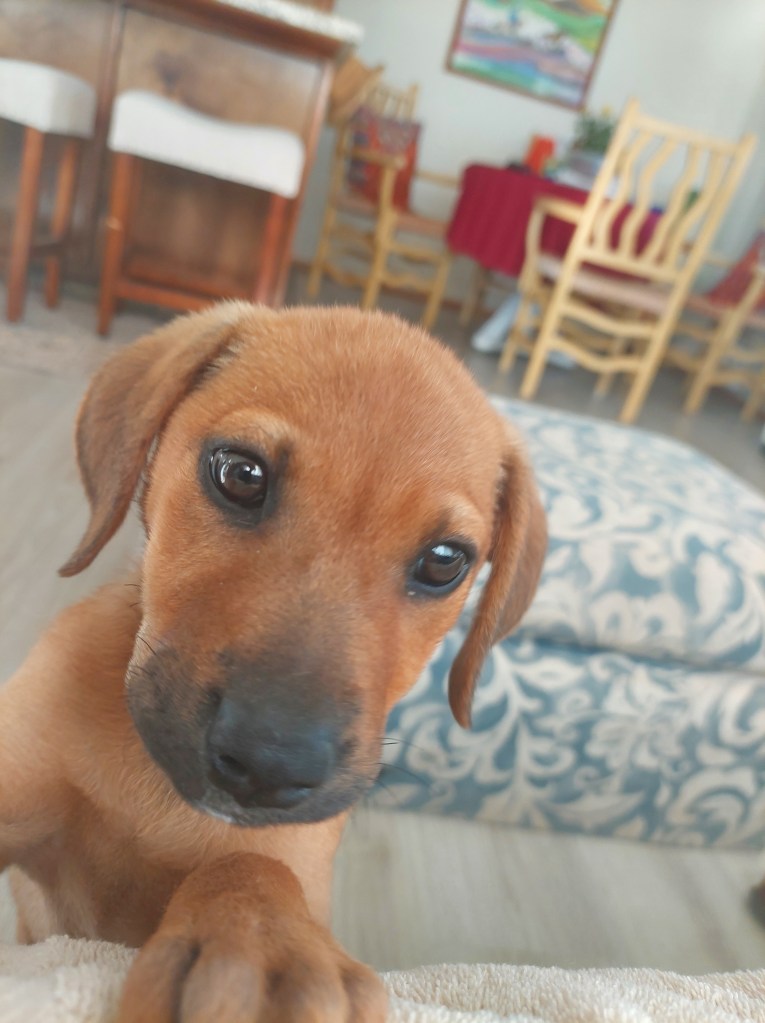
The puppy, Galleta, is having the “Zoomies,” dashing around the garden, zigging-zagging among young trees and potted plants squeezing between lawn chairs, disappearing behind the house then,like a magician, reappearing moments later.
The senior dog, MIcki, sits on the deck balefully eyeing the new arrival, whom she despises.
Evenings Micki sits on her dog bed enduring Galleta’s face licking but doesn’t respond. The puppy will then adopt a paws down pose that means, “Let’s play,” and is ignored. Frustrated Galleta leaps in circles and then begins to furiously bark for Micki’s attention. At which point, the older dog, having made her point, either gets up and walks away or growls a warning to, “back off.” Defeated the rejected pup, who wants to be friends with the other member of her species in the home, retreats to find a toy, or leaf to play with, or jumps on to my lap.
My eight year history with Micki doesn’t fill me with faith in her changing her behavior soon, or ever.
She is not the first dog I’ve rescued. My first dog was a red Rhodesian Ridgeback mix, who a year after she inhaled a “Fox Tail,” a pointed sharp weed, widespread in California and the west that travels once it has entered the body. A local McVets in San Diego, performed emergency surgery. When it was over, I was told,
“We think we got it all.”
Shortly after that I retired to the north Pacific Coast of Mexico. Less than six months after our arrival later, she collapsed as we walked along the ocean.
Rushing her to a local vet, a blood test revealed several comorbidities. The local Veterinarian’s main business was vaccine injections and flea baths. He suggested he take my dog to a Veterinarian an hour away in the nearest city for an X-ray and possible surgery. Although she was now able to walk, her distress was evident. He read her results and her age, approximately twelve years old. I knew this was older than average for a dog her size. I took her home to think and cooked her a dinner of chicken, rice and carrots which she ate in a flash. We had a normal evening together, but in the morning she struggled to stand and walk and couldn’t. We’d had one last precious night together. Her lab report suggested she was dying. It was obvious to me she was suffering and frightened. Was I going to make my closest companion of a dozen years suffer because of my cowardice. I had promised when I adopted her to always be with her. I kept that promise.
I had no idea the pain I would feel after the loss of my beloved red dog. No human death had affected me in that way. Anyone who has ever had an animal they loved die, knows what I mean.
Kindhearted friends suggested I get another dog. Dutifully I visited dog rescues and answered ads, but I was no where near ready for such an event. And though I am an agnostic, for years, I secretly clung to a childish wish for her reincarnation.
Years later while I washed breakfast dishes and gazed absently out the kitchen window of a beach house I’d recently moved into, I saw a red dog trotting the dirt road toward me. My heart raced as I shut off the faucet and rushed for the front door, drying my hands on my jeans as I hurried to greet the vision of my dead dog.
There was no sign of the dog I’d seen or thought I’d seen. Was it a ghost? A hallucination? Had I finally lost my damn mind?
A few weeks later driving past a nearby house along the estuary, I saw the red dog again. It was one of a pack of loose dogs that lived there.
So it wasn’t my imagination and I knew it was time to adopt another dog. Not one that resembled my last.
I was seven years older, about to enter my eighties. A small dog would be a good choice. A lap dog would be nice, I thought.
I visited the local shelter, a roofless structure made of donated wood that had three open a kennels: one for small to mid-size dogs. The dogs were fed twice daily at an open trough. When I entered I was immediately surrounded by affection-seeking dogs of various sizes. A little white dog made her way through the huddle and put her fore paws on my knees. She looked like a mix of Westie and Chihuahua. Her dark eyes, seemed to plead, “Choose me.”
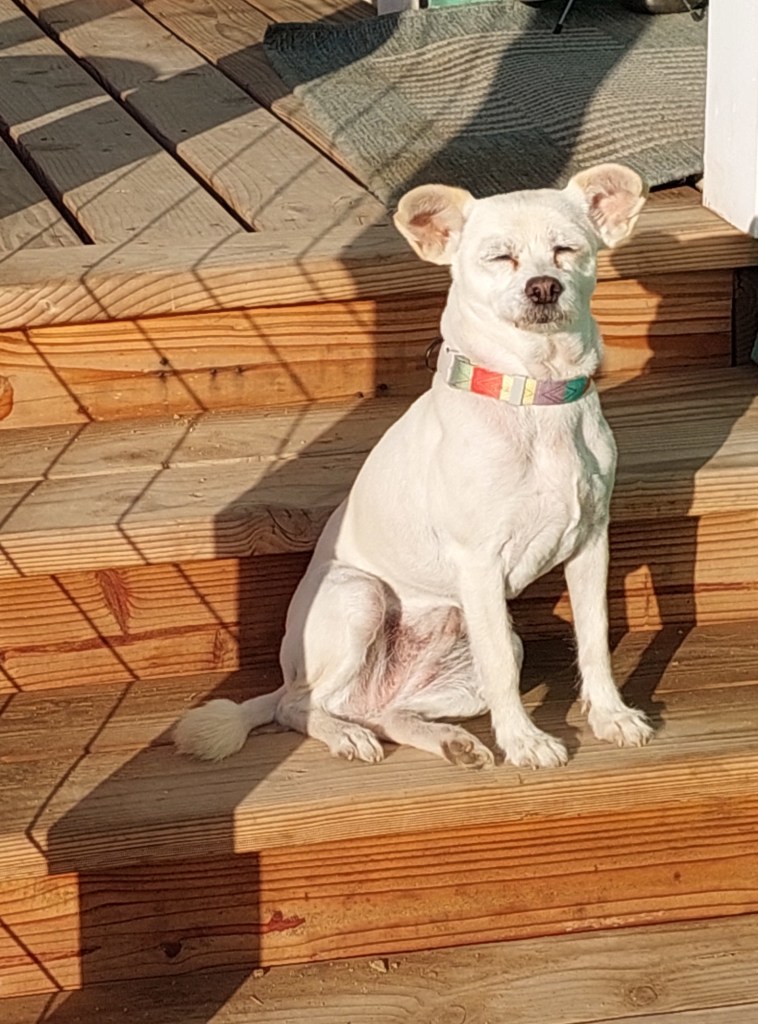
The volunteer told me the dog had been there over a year, was spayed, vaccinated, and in good health. She’d been adopted two weeks ago but soon returned.
“They dumped her and drove away,” she told me.
I felt sorry for the little dog’s plight, (not a thought about why previous adopters had been so desperate to be rid of her.) Plus, the timing was just after the winter holidays. I felt it was time for a fresh start.
They say, whom ever “they” are, that, “the first step is the hardest.” There is no mention how hard the rest of the steps may be.
I named her Micki. She was intelligent, energetic and enjoyed walks. And food. Lots of food. Her adorable looks attracted when we were out walking. Little children ran to pet her under my watchful eye. Adults often asked to pick her up and hold her in their arms.
This rarely turned out well.
Twenty seconds after being lifted when she realizes nothing edible is involved, Micki kicks and squirms for release. This can feel like a rejection. Because it is.
Over the years I’ve learned to live with her rejection, among other quirks like:
She is a dog that stares. This is a form of dog communication. It’s up to you to figure out what it means.
She is not a lapdog.
She is very independent.
On the plus side, she likes long walks, as do I.
She is unafraid of large dogs. I’ve seen her make a too nosy or frisky large dog back off with her body posture and a sharp bark.
Also, she doesn’t bark much.’
Correction: she didn’t bark much until the puppy joined our home.
Now Micki barks at anything—human, animal, car, a door opening, a car engine starting, a falling leaf.
I think Letta’s love has driven Micki a little psycho.
The thing is, all these behavioral issues would have been avoided if only what I imagined would unfold had happened. When I began thinking of adding to our household, I observed Micki playing with larger neighborhood dogs and had seen her bristle and bark at a dog four times her size and see it back off.
She’s a tough little one who can handle herself and I thought that instead of another small, adult dog rescue, I could get a puppy. Micki would train the puppy and as it grew larger, the pup would recognize Micki as the boss. Win-win.
I very much missed having a dog to cuddle. We interviewed half a dozen dogs—grown and puppies—but didn’t find the a contender. One dog when introduced rushed us fiercely barking. The volunteer pulled it back before any damage was done. Another time, answering an ad, we drove to a rural property where a woman had four, small dogs, two were available. I don’t like to be judgemental but these dogs were in need of a bath and trim. They quickly herded Micki into a corner, sniffing her front and back.
“They’re friendly,” the owner kept repeating. Micki disagreed and took off hide under my car.
I didn’t give up finding a suitable dog puppy, but I did lower my expectations.
One morning as we returned from our morning walk along a dry riverbed, a man with thinning, grey hair and dressed in gardening clothes approached us, holding a small tan puppy in his arms.
“I just found this puppy; do you want her?” He held her up for inspection.
And answered my question before I could ask.
“She’s female.”
I grinned, “Yes, very much. Thank you,” and held out my hands for her.
He placed the tiny puppy with the big belly in my hands.
As we walked away I leaned over her to whisper,“I finally found you. I’ve been looking for so long.”
A few hours later at the young veterinarian’s office, Galleta received a dewormer and a blood test.
That night I held her in my arms as she slept exhausted and safe.
The next morning, the Vet called with lab results. Galleta was in good health, nothing, except parasites which she’d was treated for the day before, and had already begun to shed. He estimated she was probably two months old, weaned maybe only two weeks before she was thrown away and then found. He guessed from her tan color, ears and body shape that she was part Labrador. I agreed and since I’d seen purplish-blue marks on her tongue that were similar to my beloved red dog that she was part Ridgeback.
Lab/Ridgebacks are known to be family dogs and very loving.
I named her Galleta, which means “cookie” in Spanish. I call her “Lleta.”
From the start, Micki shunned the pup. I mean, she just “iced” Lleta as if she didn’t exist. Lleta would try to get close to Micki, the other member of her species, lick Micki’s mouth, and puppy-squea for Micki to respond. Sometimes Micki just got up and walked away; at others she gave a sharp growl and Galleta would retreat or come to me.
When I’m watching television or reading, Lletta is beside me, napping or chewing on a toy. Micki is seated on her dog bed across the room, as she has been for years, staring at me.
Evenings, I’d watch a movie on television while Lleta snuggled next to me in a chair or rested in my lap, her nose nuzzled in my armpit.
Micki, seated across from us in the comfortable living room chair, would stare at us with a baleful expression I interpreted as,
“How long am I going to have to put up with this crap?”
And then Micki went through a stage of rage. She’d suddenly gallop across the living room, jump on me, barking and pushing the puppy aside.
All the while she rebuffed Galetta’s attempts at friendship. And then poor Micki started having panic attacks. She’d shake all over with a wild look on her face. I had some CBD drops I thought I’d use one day but opened them to use for Micki.
The next morning, we were at the Vet’s office. He showed me how much CBD to give her twice a day to calm her. This behavior passed in two weeks, when Micki seemed to go into some sort of sad acceptance that things had changed.
My fantasy that the small dog would train the puppy before she grew larger vanished into thin air.
Galleta became my dog. She’s now six months old and three times larger than Micki. If she sees Micki approach me, she stands at attention. Micki stops and turns around.
There are no fights. No biting. But I feel sorry for Micki. This was not what I imagined. I never anticipated that Micki, who I’ve seen make a bigger dog back away, would let a puppy grow to a size where she can intimidate her.
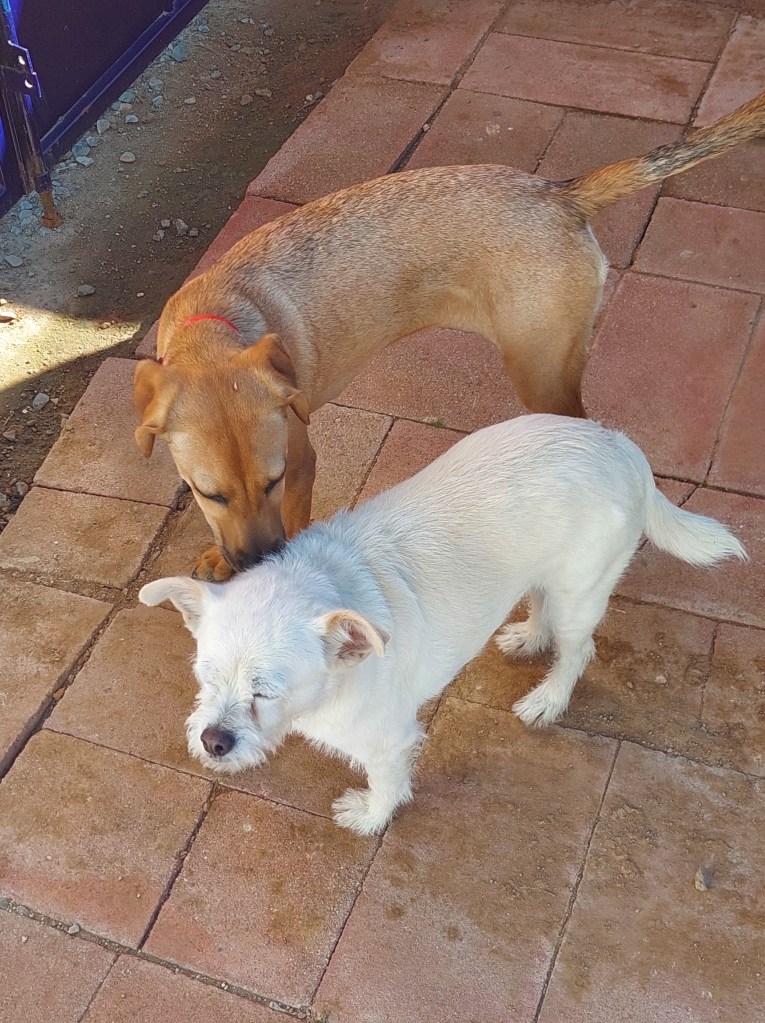
Now, when Micki ignores Galleta and she gets frustrated and barks for her attention, I have to put my foot down.
“Nope. No barking inside the house,” and shoo them outside.
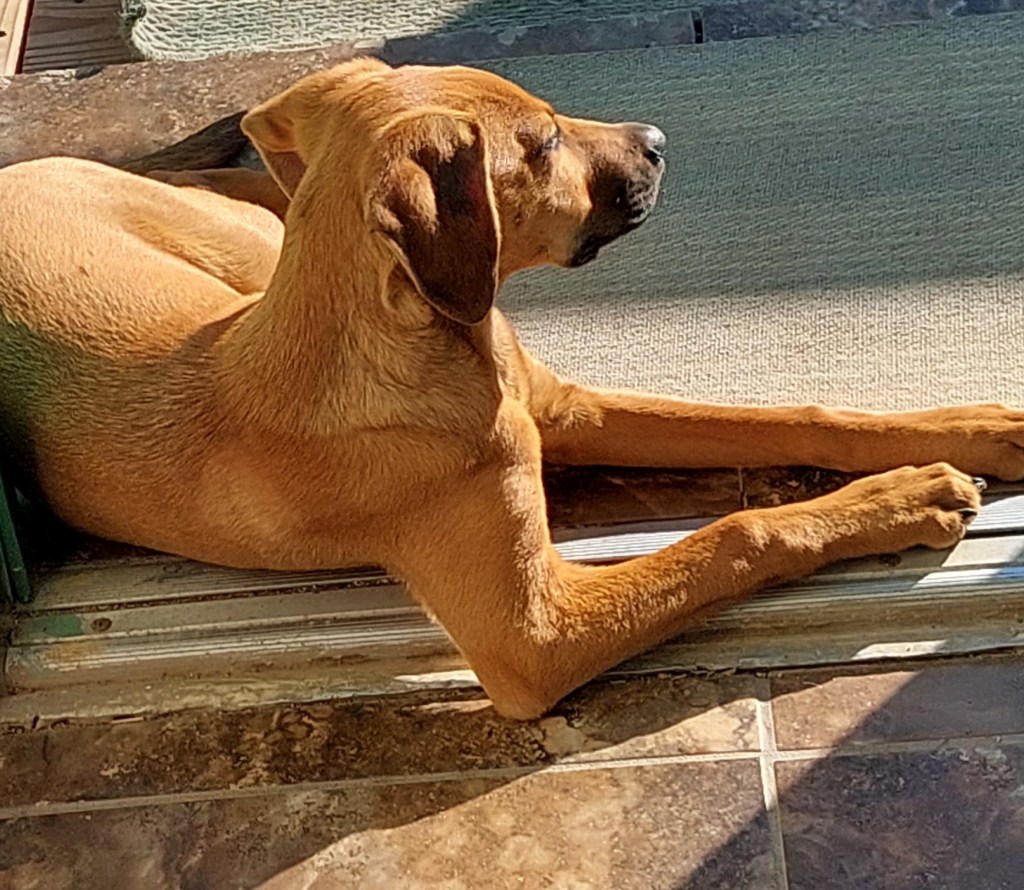
Lleta is big enough to sleep through the night curled beside me.
My dilemma is that I love both my dogs. I do. I love Micki with my head, but I love Galleta with my heart, and it wants what it wants.
written by Carol Roper
ⒸCarol Roper Copyright 2026
Please share with attribution to author.
This work is licensed under a Creative Commons Attribution-Noncommercial-No Derivatives 4.0 International License. Under the following terms: Attribution — You must give appropriate credit, provide a link to the license, and indicate if changes were made. You may do so in any reasonable manner, but not in any way that suggests the licensor endorses you or your use. Noncommercial — You may not use the material for commercial purposes. No Derivatives — If you remix, transform, or build upon the material, you may NOT distribute the modified material.

Leave a Reply